How to get from
Ljubljana to Bled
How to get from Ljubljana to Bled
Short distance, different travel choices
Ljubljana and Bled are close on the map, which is why many travelers treat this as one of the easiest transfers in Slovenia. The distance is about 55 kilometers, and by car the trip normally takes around 40 to 50 minutes in ordinary traffic. That makes Bled close enough for a day trip, but the way you travel still matters, especially if you are carrying luggage, arriving from the airport or railway station, or planning to check into accommodation near the lake rather than just visit for a few hours.
The main choices are private transfer, self-driving, train, and bus. Each one can make sense, but they do not serve the same type of traveler. A private transfer gives the simplest door-to-door journey. Driving gives freedom but adds parking and vignette details. The train is efficient if you are comfortable with the final local transfer from Lesce-Bled. The bus is often the cheapest direct public option into Bled itself. Flights do not play a useful role because the distance is too short and Bled does not have a commercial airport.
Direct transfer without station changes
A private transfer from Ljubljana to Bled is the easiest way to make the trip when the goal is a smooth arrival rather than simply reaching the nearest station or bus stop. The driver collects you from your hotel, apartment, Ljubljana Airport, the railway station, or another agreed address, and takes you directly to your accommodation in Bled. That door-to-door setup removes the need to handle tickets, platforms, taxi ranks, local buses, or luggage changes at the end of the trip.
The distance is short, but comfort still matters. Travelers with large suitcases, ski bags, baby equipment, or several small bags often find that public transport becomes less convenient than expected. A private transfer keeps the trip continuous, so luggage stays in the vehicle and the timing is easier to predict. It also saves time because the day is not built around departure boards. For families, older travelers, small groups, or guests arriving after an international flight, the difference is less about kilometers and more about avoiding a fragmented travel day.
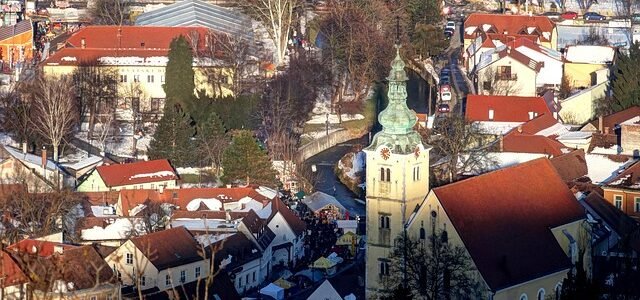
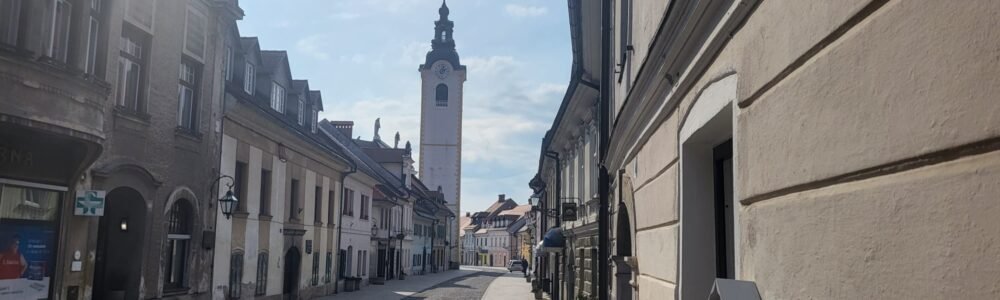
Kamnik can be included first if travelers want a detour toward the northern edge of the Ljubljana Basin before turning back toward the Gorenjska region. The town stands below the Kamnik-Savinja Alps, with a compact center, old streets, and clear mountain orientation. It is not on the fastest road to Bled, but it makes sense for travelers who want to see a different side of central Slovenia before moving west.
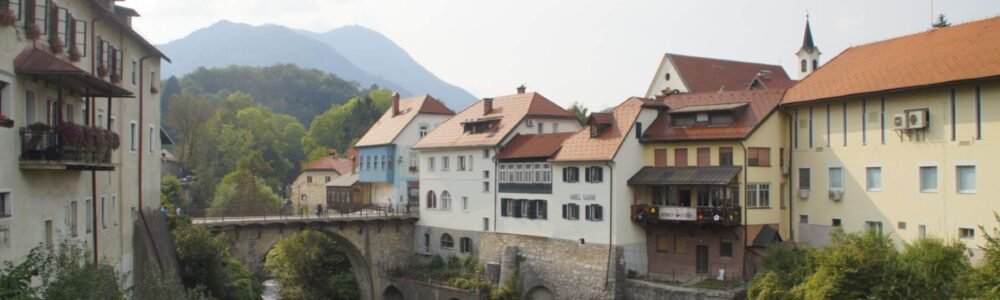
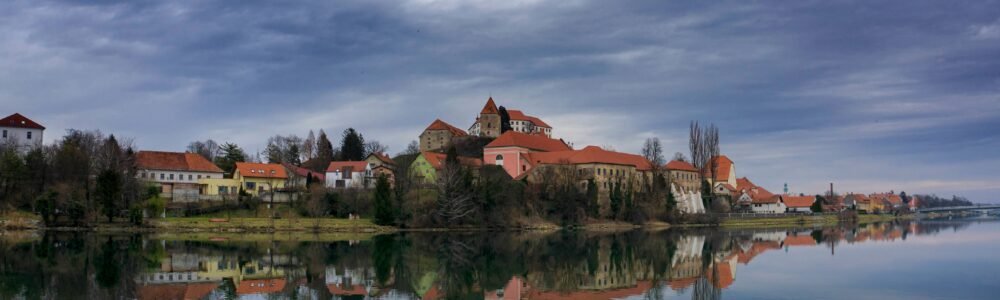
Škofja Loka gives the transfer a slower, older-road character. It is west of Ljubljana and close enough to combine with the trip without making the day feel overextended. Travelers usually spend time around the main square, the bridges, and the upper town area before continuing toward the alpine side of Slovenia.
Kranj is the most practical pause geographically because it is already in the wider corridor between Ljubljana and Bled. It is one of the main towns of the Gorenjska region and can be used for a short walk, coffee, or lunch before the final approach. With a private transfer, these pauses can be planned without worrying about bags or fixed public transport departures, while the final part of the journey still ends directly at the chosen address in Bled.
Taking the wheel yourself
Driving from Ljubljana to Bled is simple in road terms. Most drivers use the motorway toward the northwest and then continue from the Lesce area into Bled. In normal traffic, the driving time is often under one hour, but weekend departures, summer afternoons, bad weather, and busy holiday periods can slow the final stretch. Navigation apps usually handle the trip well, and the road quality is good, so the main practical questions are cost, vignette rules, and parking.
For a standard car, the driving cost is usually modest if you already have access to a vehicle. Fuel for the Ljubljana to Bled distance is often around €8–€15, depending on consumption and current prices. Slovenia does not charge ordinary passenger cars with separate motorway toll booths on this kind of trip, but a valid e-vignette is required for motorways and expressways. The weekly Slovenian e-vignette for a standard passenger car is €16.
If you rent a car, check whether the vignette is already included. Many Slovenian rental cars have one, but it is better to confirm instead of assuming. If the car does not have a valid vignette and you use the motorway, that cost must be added. Parking in Bled is the other expense. Close-to-lake parking is often paid and can be limited during busy periods, while hotels and apartments vary widely in what they provide.
Driving yourself usually costs around €25–€45 in direct travel expenses if you need to include fuel, vignette, and some parking, before any car rental charge. It is a good option if Bled is part of a wider Slovenia itinerary and you will continue toward Bohinj, the Julian Alps, or other places after arrival. If you only need transport from Ljubljana to one hotel in Bled, a car may be more useful during the transfer than during the stay itself.
Rail option via Lesce-Bled
Train travel from Ljubljana to Bled is practical, but travelers should understand where the train actually arrives. The main railway station for most visitors is Lesce-Bled, not the lakeside center of Bled. Direct trains from Ljubljana to Lesce-Bled can take around 50 to 60 minutes on some departures, and Slovenian Railways timetables show direct services with travel times such as 56 minutes.
After arriving at Lesce-Bled, you still need to reach the lake area, which is several kilometers away. That final part can be done by local bus, taxi, or pre-arranged pickup. Seat61 notes that trains between Ljubljana and Lesce-Bled run roughly hourly, with faster services around 40 minutes and local trains usually around 54 to 70 minutes; it also notes local buses from outside Lesce-Bled station to Bled old town, taking about 9 minutes with a low local fare.
Train tickets are usually inexpensive by European intercity standards. A realistic budget is around €6–€10 per person for the rail part, with a small extra cost if you use a local bus or taxi from Lesce-Bled to your final address. The train is comfortable for the short ride, with more space than a bus and less dependence on road traffic. It suits travelers who are starting near Ljubljana railway station and packing lightly.
The disadvantages appear mostly at the edges of the journey. You need to get to Ljubljana station, choose a suitable departure, manage luggage on and off the train, and then handle the last part from Lesce-Bled. For a day trip with a small backpack, that is usually fine. For a family with suitcases or travelers arriving from a flight, the train can feel less direct than the travel time suggests.
Bus travel from the capital
The bus is often the most straightforward public transport choice from Ljubljana to Bled because it takes passengers from Ljubljana Bus Station to Bled itself. The departure point in Ljubljana is next to the railway station, which makes it easy to find, and the arrival in Bled is more convenient for many visitors than Lesce-Bled railway station. Current Ljubljana Bus Station timetable pages show regular departures between Ljubljana and Bled, with individual services taking around one hour to a little over one hour depending on the exact departure.
Bus ticket prices are usually low. A realistic budget is around €6–€10 per person one way, with some published travel guidance placing a Ljubljana to Bled bus ticket at about €6.30 and other current reporting placing the cost at roughly £5.20. Prices can vary by operator, date, and ticket channel, so it is still worth checking the exact fare before travel.
The bus suits travelers who want a direct public connection without thinking about the final transfer from Lesce-Bled. Luggage usually goes in the coach storage area, which can be easier than carrying bags through a rail station. For solo travelers, couples, students, and budget-focused visitors, it is usually the simplest low-cost answer.
The trade-off is schedule control. During busy travel periods, popular departures can fill, boarding can take longer, and traffic can affect arrival time. The bus is also less comfortable than a private transfer if you are traveling with children, multiple bags, or a fixed hotel check-in time. Still, for a short Ljubljana to Bled trip, it remains one of the most useful public transport options.
Why flying does not help
Flights are not a realistic way to travel from Ljubljana to Bled. The two places are too close, and Bled has no commercial airport that would make a city-to-city flight possible. Ljubljana Airport is actually northwest of Ljubljana, partway in the general direction of Bled, so going through an airport process from the capital would not shorten the trip. It would add check-in time, security, waiting, and another road transfer.
Even if a traveler tried to build an indirect air itinerary through another airport, it would make no practical sense. The price would usually be far higher than train, bus, driving, or private transfer, and the total time would likely be several hours longer than going by road. There is no meaningful normal plane fare for Ljubljana to Bled, because the journey is not served as an air route.
A realistic flight comparison would only apply if someone is already landing at Ljubljana Airport and wants to continue to Bled from there. In that case, the relevant question is not flying from Ljubljana to Bled, but arranging a road transfer from the airport to Bled. For travelers starting in Ljubljana city, ground transport is clearly the correct category.
Because of this, flights should be treated as impractical rather than simply expensive. They do not match the geography of the route. The short distance, strong road connection, and available bus and train options mean that air travel adds complexity without solving a real transport problem.
Which option is best
Private transfer offers the easiest door-to-door trip, especially with luggage, family travel, or a fixed arrival time.
Driving provides independence and a quick journey, but parking and the Slovenian motorway vignette need to be planned.
Train travel suits passengers who are starting near Ljubljana railway station and do not mind the final transfer from Lesce-Bled.
Bus travel is the most direct low-cost public option into Bled itself.
Flights are not useful because there is no practical air connection for such a short route.
First steps after reaching Bled
Arrival in Bled is usually simple, but the experience depends on where your transport leaves you. A private transfer brings you directly to the hotel, apartment, villa, or guesthouse, which is the easiest outcome if you have luggage. A bus arrival is often convenient for the central area, while a train arrival at Lesce-Bled still requires a local transfer before you reach the lake or your accommodation.
Bled is not large, but it is not one single compact point either. Accommodation can be near the lake, above the center, in quieter residential areas, or closer to the road toward nearby villages. This matters more with luggage than it does during sightseeing. A walk that looks short on a map may feel less convenient with suitcases, rain, summer heat, or an evening arrival.
Drivers should decide where to leave the car before getting close to the lake area. Parking near the water can be busy and paid, and traffic around the most visited parts of Bled can move slowly during weekends and holiday periods. If your accommodation includes private parking, it is often best to go there first, unload, and continue on foot later.
Once you are settled, local movement is easy. Many visitors walk around the central lake area, use short taxi rides when needed, or rely on accommodation advice for local transport. The first impression is usually slower and more open than Ljubljana, but not remote. Bled receives many visitors, so practical planning around arrival time, parking, and luggage makes the difference between a smooth start and an unnecessarily awkward one.
How many nights make sense
Two nights in Bled are enough for a short stay after leaving Ljubljana. That gives you one full day without needing to rush immediately onward. For many visitors, this is enough time to walk around the lake area, settle into the slower pace, and enjoy the destination without turning the transfer day into the only real day there.
Three nights are better if you want a more relaxed visit or if Bled is part of a wider Slovenia trip. An extra night gives more flexibility with weather, meals, lake activities, and nearby excursions. It also helps if you arrive later in the day, because the first evening can be used only for check-in and a short walk rather than detailed planning.
A longer stay can make sense if you are using Bled as a base for the surrounding alpine region. In that case, the value of staying longer comes from having time for nearby valleys, lakes, viewpoints, and outdoor activities without packing again every morning. Travelers who prefer a slower itinerary often find that Bled works better over several nights than as a rushed day trip.
For most people traveling from Ljubljana, two to three nights is the best balance. The journey is short enough that you do not need a recovery day, but Bled is different enough from the capital that it deserves more than a quick arrival and departure. The right length depends mostly on whether Bled is your main Slovenia stop or one part of a longer route.
Making the transfer feel easy
The Ljubljana to Bled trip is simple when planned around the whole travel day rather than just the distance. If you want the least complicated option, a private transfer removes the station changes, local transfers, luggage handling, and timing issues. If you are comfortable driving and have a valid vignette, the road journey is quick and flexible. If price matters most, the bus gives a direct public connection into Bled at a low fare.
Train travel is also a solid choice, particularly for travelers who like rail journeys and are happy to finish the trip from Lesce-Bled by local transport. Flights should be ignored for this route because they do not suit the geography. Before choosing, think about where you are starting in Ljubljana, where you need to arrive in Bled, how much luggage you have, and whether the transfer is part of a relaxed stay or a tightly timed travel day.
The route is short enough that no option is difficult, but the details still shape the experience. A traveler with only a backpack may be perfectly happy on the bus or train. A family arriving from the airport may value a direct transfer far more than the price difference. A visitor continuing around Slovenia may prefer a car. Matching the transport to the trip is more important than choosing the theoretically fastest option.
For official visitor information, maps, and seasonal updates, visit the official tourism website.